


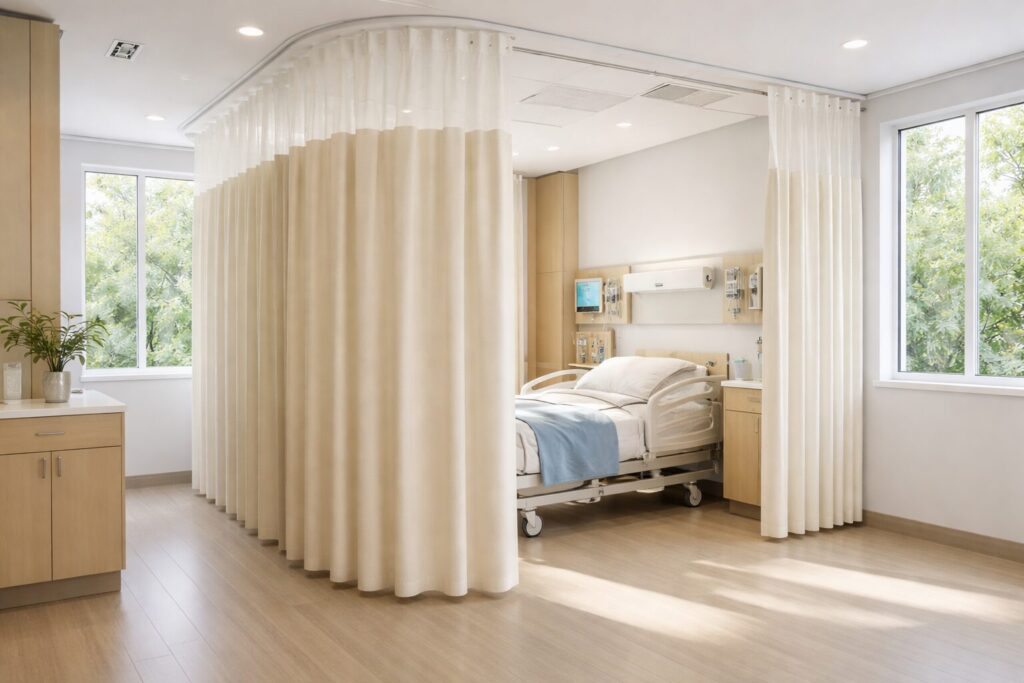
What Are Hospital Curtains and Where Are They Used
Hospital curtains are an often overlooked staple of a clinical environment – but they are an incredibly important part of patient and staff wellbeing. Hospital curtains are screens suspended from ceiling-mounted or wall-mounted track systems, creating instant separation between patients in shared spaces. While they’re most associated with acute hospital wards, their use extends well beyond — you’ll find them in GP clinics, specialist consulting rooms, aged care facilities, disability support settings, and even home care environments where dignity and discretion matter.
Wherever personal care or clinical treatment takes place, hospital curtains provide a simple, cost-effective way to create private zones without permanent structural changes. Browse our full range of hospital curtains and screens to find the right fit for your environment.
Why Privacy Matters in Healthcare Settings
Privacy isn’t a luxury in healthcare — it’s a clinical and ethical requirement. Patients undergoing treatment, assessment, or personal care have a right to dignity, and curtains play a direct role in upholding that. A well-positioned curtain reduces the anxiety that comes with feeling exposed in a shared ward, encourages patients to communicate openly with clinicians, and demonstrates a facility’s commitment to respectful, person-centred care.
In aged care and home settings, this is equally important. Maintaining a sense of personal space for residents and clients supports emotional wellbeing alongside physical care.
How Hospital Curtains Support Infection Control
Infection control is one of the most critical considerations in any healthcare environment, and curtains are a key part of that picture. Fabric surfaces can harbour pathogens if not managed correctly, which is why both disposable and washable curtain options exist to address different hygiene protocols.
Disposable curtains, such as the Haines disposable range, are designed to be replaced at regular intervals — or between patients in high-risk areas — eliminating the laundering process and reducing the risk of cross-contamination. Some of these curtains are even manufactured from antimicrobial materials to further boost infection control capability. Reusable curtains, when laundered according to infection control guidelines, offer a durable and cost-effective alternative for lower-risk environments.
Choosing the right curtain type for your setting is one of the simplest ways to strengthen your facility’s hygiene standards.
The Role of Curtain Tracks in Flexible Care Spaces
A curtain is only as effective as the track system supporting it. Curtain track kits are mounted to ceilings or walls and allow curtains to be drawn, retracted, and repositioned with ease — adapting to changing patient numbers, room configurations, or care requirements.
Modern track systems can be configured in straight runs, L-shapes, or U-shapes to wrap around beds and treatment areas completely. Because every space is different, our curtain track kits are custom manufactured to order, with a lead time of 5–10 business days — ensuring you receive a solution built precisely for your environment.
Different Types of Hospital Curtains and Screens
There’s no one-size-fits-all approach to healthcare privacy. The main options include:
- Disposable curtains — Ideal for high-risk infection control environments, replaced regularly without laundering.
- Reusable/washable curtains — Suited to general wards and clinics with established laundry protocols.
- Mobile folding screens — Freestanding and portable, these screens can be repositioned anywhere in a room without any wall or ceiling fixings, making them ideal for flexible or temporary spaces.
Each option serves a different purpose, and many facilities use a combination across different areas.
Choosing the Right Curtain or Track System
When selecting a curtain system, consider the following:
- Environment type — Is this an acute ward, an aged care room, a consulting space, or a home setting? Each has different privacy and hygiene demands.
- Infection control requirements — High-risk clinical areas typically benefit from disposable curtains, while lower-risk spaces may suit washable options.
- Space and layout — Fixed track systems suit permanent spaces; mobile screens offer flexibility where layouts change.
- Usage frequency — High-traffic areas need durable, easy-to-replace solutions.
Our ward and clinic range covers everything from curtain track components through to complete privacy solutions.
Supporting Safer and More Efficient Care Environments
Beyond patient comfort, a well-designed curtain system contributes to safer, more efficient care delivery. Staff can create private spaces quickly without relocating patients, clinical workflows are less disrupted, and hygiene compliance becomes easier to maintain.
When curtains and tracks are chosen thoughtfully — matched to the environment, usage patterns, and infection control standards — they become an integral part of a facility’s care infrastructure rather than an afterthought.
Whether you’re fitting out a new ward, upgrading an aged care facility, or sourcing solutions for individual home care clients, the right privacy system is closer than you think.
FAQs
Hospital curtains are used to create privacy and help manage infection control between patients in shared spaces such as hospitals, clinics, and aged care facilities.
Disposable curtains can help reduce the risk of cross-contamination as they are replaced regularly instead of washed — making them a strong choice for high-risk clinical areas. Some disposable curtains are made with antimicrobial material to help reduce the risk of infection spread.
A curtain track system is a mounted rail that allows privacy curtains to be easily installed, moved, and adjusted to suit different room configurations.
They are also widely used in aged care, disability support settings, and home care environments where patient dignity and privacy are important.
Curtains are fixed to ceiling or wall-mounted tracks, while privacy screens are mobile and can be repositioned freely as needed.